
How to Design Lead Generation Landing Pages - Tips & Examples
Wish to drive quality leads for your business? Then, read here and learn tips and tricks to design lead-generation landing pages that boost engagement.


Landing pages look simple, but building ones that convert isn’t. Behind every clean layout is a mix of design psychology, code efficiency, and behavioral insight.
If you’re building a platform, your users expect drag-and-drop freedom, responsive previews, and the ability to publish fast, without touching code. If you’re the one designing those pages, you care about what makes people stop scrolling, click, and act.
This guide speaks to both. It breaks down key design elements like hero sections, structure, responsiveness, and media use, and shows how to build or enable them. You’ll see what works, why it works, and how top brands like Vimeo and Chanel apply these ideas.
Whether you’re a developer embedding a builder or a designer using one, understanding both sides is what turns a simple page into a high-performing one.
It’s easy to underestimate how much impact a single landing page can have. The right design can turn passive visitors into active customers, making it one of the most valuable tools in your marketing stack.
For marketers, landing pages help you:
Generate high-quality leads by channeling traffic to goal-specific pages instead of your homepage.
Give every campaign a dedicated home where the value exchange (data for content) happens.
Collect demographic and behavioral data from every form submission to refine targeting.
Identify which leads are most engaged based on reconversions and repeat visits.
Power multiple channels, such as email, PPC, and social, with optimized, shareable campaign pages.
Measure and compare campaign performance using clear, page-level analytics.
Landing pages aren’t only about visuals; they’re also about performance, scalability, and flexibility. Building one that loads fast, tracks user behavior correctly, and connects seamlessly to backend systems is a technical challenge, not a design one.
That’s why developers play a decisive role in how well landing pages perform in real-world campaigns.
Here’s how landing pages become a developer’s domain:
Performance optimization: When pages load in one second, the average conversion rate is almost 40%. But with a two-second load time, the conversion drops to 34%. That gap is entirely in the developer’s hands, achieved through optimized code, lazy loading, and lightweight asset delivery.
Scalability: Managing 10+ campaigns with consistent layouts, global components, and reusable modules is only possible with an innovative front-end architecture.
Accurate event tracking: APIs must capture the right user actions, form submissions, and analytics events without breaking under traffic spikes.
System integrations: Devs ensure that every signup or click syncs perfectly with CRMs, ESPs, and attribution tools.
Cross-device responsiveness: You own the responsibility to ensure every block, form, and CTA behaves perfectly across screen sizes.
Version control and rollback: The ability to version, roll back, and reuse landing page templates saves hours of rebuild time during updates or A/B tests.
In short, landing pages are where marketing ambition meets engineering precision, and developers are the ones making sure that connection works at scale.
Now, let's explore the core design elements that make landing pages effective and how to implement them properly.

A successful landing page is not defined by visuals alone. Visitors should be able to instantly understand the value offered and feel assured that taking the next step is worthwhile.
Design choices influence how easily users can find key information, evaluate credibility, and progress without friction. For teams focused on crafting the user experience, the goal is to support clarity, relevance, and motivation at every stage of the page.
Try including the following elements to elevate both user experience and conversion rates:
You'd be surprised to know that over 62% of internet users browse the web through mobile devices.
This means that if the lion's share of people access the web through smartphones, you must ensure that your landing page designs are responsive and display well on all devices.
Your landing page's hero section is the first thing that grabs a viewer's attention. So, it deserves your special attention and design focus.
To create an outstanding and well-performing hero section, make sure these questions are clearly answered through your design and copy:
What do you offer the visitors?
Why should they trust your brand?
How will your brand benefit the users?
What action do they need to take to get the most out of that benefit?
You can add attention-grabbing CTAs, headings, testimonials, and design elements to create a hero section that justifies its name because this is where your viewer will make the decision to stick around or leave!
According to research, 85% of people say that color is a primary reason for purchasing a product. So, you must choose colors that align with your brand's identity and product or service to win over your subscribers.
Also, color psychology has a big influence on moods. Therefore, try to choose colors that positively impact your viewer's mood, such as yellow, green, light blue, and orange.
Another important role that colors play is highlighting the elements of your page. For example, if you use a contrasting color for your CTA, people are more likely to notice and click on it.
Minimalist designs include sufficient negative space, fewer design elements, and are easier for visitors to digest.
Besides looking visually pleasing, they are great at creating visual hierarchies and communicating messages more effectively.
Minimalist designs are great at communicating messages more effectively because they have:
Visual hierarchies
Strong visual appeal
A layout pattern (like Z or F) that naturally leads the eye to the primary CTA
Stick to a simple, structured design. Avoid color-heavy or cluttered layouts that can overwhelm users. Even if you use interactive or animated elements, keep them subtle to maintain visual flow.
38.6% of marketers say video is the number one landing page element influencing conversions. Adding a concise video demo or walkthrough can directly improve engagement and conversion rates.
In addition to boosting engagement, videos help your viewers understand your product/service quickly and thoroughly.
However, when including videos, remember to create an enticing thumbnail, turn off autoplay, add subtitles, and include a CTA.
Your hero grabs attention, but the rest of your copy keeps it.
Every headline, section header, and CTA should reinforce your offer and move the user closer to conversion. Use a consistent tone, avoid jargon, and tie every message back to a clear action.
Testimonials provide proof that real people have already benefited from your product or service. They reduce uncertainty, especially for first-time visitors who are still evaluating whether your offer will deliver the result they want.
Highlight authentic customer feedback with clear names, photos, or company logos to make it more believable and visually consistent with your page design.
Color is one of the first things users notice, and it influences how they feel about your brand instantly. Over time, people begin to connect certain colors and styles with your product, making your brand more recognizable even before they see the logo. Think of how some brands can be identified by just a shade of blue or a signature gradient.
Choose colors that truly reflect your brand’s personality and promise. Luxury products usually call for refined, understated tones, while energetic or youthful brands might go for bolder contrasts.

Users today expect fast, polished experiences that adapt to their needs without heavy engineering effort. This means developers must create landing page components that are not only visually strong but also editable, scalable, and reusable within a visual builder.
Here's how to support the landing page design in your platform effectively:
Responsive editing: Add breakpoint-specific controls and live previews so users can adjust layouts for mobile, tablet, and desktop. Benchmark performance with tools like Lighthouse or WebPageTest to ensure smooth, fast loading.
Customizable hero sections: Offer configurable hero blocks with editable text, CTAs, and background media. Let users switch visuals or layouts per device without code changes.
Brand & theme management: Include color pickers, typography controls, and contrast validation for accessibility. Allow users to save brand palettes and apply them across templates for consistency.
Flexible layout systems: Use grid-based templates with adjustable spacing and alignment. Keep interactive modules modular so users can toggle animations or effects as needed.
Media optimization: Support responsive video and image embeds with lazy loading, custom thumbnails, and subtitle options to preserve speed and accessibility.
Rich text & A/B testing: Provide inline editing with formatting controls, headline character limits, and built-in A/B testing hooks to measure copy effectiveness.
Testimonials & social proof: Add testimonial blocks with star ratings, images, and schema markup for SEO-rich snippets. Offer layout choices like grids or carousels.
Global templates & branding controls: Enforce brand consistency through template locking, global style settings, and enterprise-ready permissions.
Smart layout patterns: Provide prebuilt Z-pattern and F-pattern layouts, drag-and-drop reordering, and responsive grids that keep designs aligned across screen sizes.
We collected some valuable tips from SMEs about designing landing pages for conversion and compiled them here. Their advice centers on keeping copy value-driven, using short videos to encourage action, and balancing white space for clarity.
These expert tips focus on design and conversion best practices, perfect for marketers and designers optimizing user-facing pages. If you're a developer, these insights can inform which features to prioritize in your platform to empower your users with similar creative flexibility.

You might be looking for some inspiration by now, and we've got exactly what you need. These examples showcase excellent design principles that drive landing page conversions.
For each, we'll explore what makes the design effective and how developers can enable similar flexibility in their platforms.

Industry: SaaS
Interactive elements, such as videos that speak for their product's quality.
An elegant yet captivating color palette.
Minimalist layout design.
Provide video embedding blocks with customizable thumbnails and autoplay controls.
Offer pre-built color theme templates that users can apply with one click.
Include minimalist layout options with flexible grid systems that prevent overcrowding.

Industry: Floral
Colors that easily steal any visitor's attention.
Prominent CTAs that clearly describe the action to be taken.
Accurately displayed the brand theme through design.
How to enable this in your platform:
Implement color pickers with brand palette saving for consistent color application.
Provide CTA button components with customizable text, colors, and size options.
Enable brand template systems that enforce visual consistency across sections.

Industry: SaaS
Colors that go perfectly with their SaaS solution.
An enticing yet comprehensive copy.
Social proof with the best clients mentioned in the hero section.
How to enable this in your platform:
Support industry-specific color palette presets that align with different business types.
Provide rich text editing with headline optimization tools and character counters.
Build logo grid components and testimonial blocks that can be placed in hero sections.

Industry: Beauty & Personal Care
Displays products that speak volumes about their worth.
Minimalist use of design elements.
A simple and comprehensive copy.
How to enable this in your platform:
Provide image blocks with product showcase layouts and hover effect options.
Create minimalist templates with generous white space and limited element options.
Include copy blocks with formatting controls that encourage concise messaging.

Industry: Fashion
Displays new products for promotion.
Minimalist use of design elements.
A simple and comprehensive copy.
How to enable this in your platform:
Build promotional content blocks with product feature capabilities and seasonal templates.
Enforce spacing controls that maintain visual breathing room automatically.
Support typography systems that prioritize readability and elegant simplicity.
These examples show how strong design and smart implementation work together. When you build the editor right, end-users can recreate world-class landing pages directly inside the editor.
Developers know that landing pages can be deceptively complex. Building one that’s fast, responsive, and customizable demands more than UI. It requires backend logic, template control, and ongoing updates that drain engineering time. What starts as a quick build often turns into months of patching layout bugs and managing dependencies.
Unlayer’s embeddable Page Builder solves that problem. You get full SDK and API control to integrate a scalable, secure editor into your product within minutes. Let users design pages that load in seconds while your team focuses on innovation, not infrastructure.
Embeddable SDK for rapid setup: Add a fully functional page builder to your app in minutes with just a few lines of code.
Framework-agnostic architecture: Integrates seamlessly with React, Angular, Vue, or any JS stack without dependency conflicts.
Comprehensive REST API and webhooks: Automate template management, export workflows, and event tracking through predictable endpoints.
TypeScript support with clean definitions: Ensure type safety and maintainability across your development pipeline.
Custom content blocks and UI controls: Extend the builder with your own logic, data inputs, and reusable design components.
White-label customization options: Let users match your platform’s interface with custom themes, icons, workspace styling, and replace default logos and colors with their own branding.
Version control and rollback options: Easily track design iterations and restore previous versions without code rewrites.
Flexible hosting and storage options: Choose between Unlayer-hosted or self-hosted deployments for complete data control.
Enterprise-grade uptime and security: SOC 2 compliant, 99.9% uptime SLA, and secure APIs for production environments.
Detailed documentation and starter templates: Well-documented SDK, code samples, and boilerplate projects for fast onboarding.
Cut deployment time from months to minutes. Book a demo and start building with Unlayer today.
A high-converting landing page typically includes:
Compelling headline: Grabs attention and clearly conveys the value proposition.
Engaging visuals: High-quality images or videos that resonate with the target audience.
Clear Call-to-Action (CTA): Prominent and persuasive prompts guiding users towards the desired action.
Social proof: Testimonials, reviews, or trust badges that build credibility.
Responsive design: Ensures optimal viewing across devices.
Fast loading speed: Reduces bounce rates and improves user experience.
To enhance mobile usability:
Responsive layouts: Utilize flexible grids and scalable images.
Touch-friendly elements: Ensure buttons and links are easily tappable.
Minimalist design: Reduce clutter to improve navigation.
Fast load times: Optimize images and scripts for quicker loading.
Accessible forms: Simplify forms for easier completion on mobile devices.
A/B testing allows you to compare two versions of a landing page to determine which performs better. By testing different headlines, CTAs, or layouts, you can make data-driven decisions to enhance conversion rates.
Unlayer provides a customizable drag-and-drop editor that can be embedded into your application. You can connect Unlayer's API to integrate the editor, allowing users to create and edit landing pages reliably within your platform. For a full walkthrough, check how to embed Unlayer in enterprise applications.
To make landing pages accessible:
Use semantic HTML: Properly structure content for screen readers.
Provide text alternatives: Offer alt text for images and videos.
Ensure keyboard navigation: Allow users to navigate using a keyboard.
Test with accessibility tools: Utilize tools like WAVE or Axe to identify issues.
Insights on email design, content creation, and developer productivity.
Wish to drive quality leads for your business? Then, read here and learn tips and tricks to design lead-generation landing pages that boost engagement.
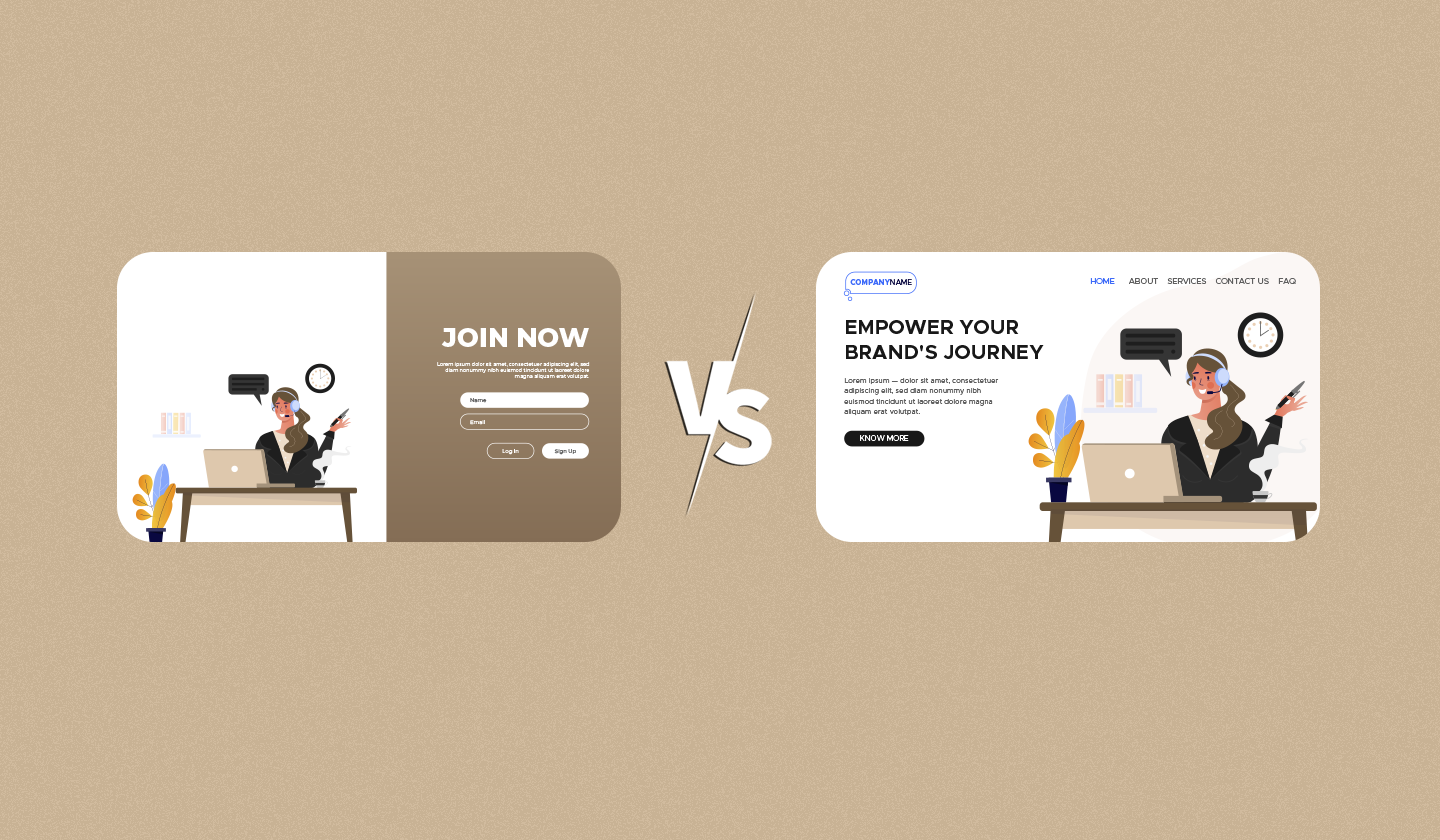
Have you been confusing landing pages with homepages? Don’t worry, you’re not alone. Read here to explore the differences between the two.
Are your landing pages underperforming? Time to identify and avoid the 17 landing page mistakes that might be leading to that. 🤔